Introduction to MPLS
What is MPLS?
- Multi-Protocol Label Switching is a new paradigm in the way routers make forwarding decisions.
- Multiprotocol: MPLS is capable of transporting many L2 and L3 protocols
- Label Switching: Packets are switched based on labels, not destination IP!
- Labels - Ultimately determine the destiny of a packet through an MPLS network
Why MPLS?
- Unified network infrastructure
- ATM concepts integrated into an IP world
- Scalable and secure L3 VPNs using a peer-to-peer model
- BGP-free core
- Traffic engineering capabilities
- WAN Quality of Service (QoS) requirements
MPLS Key Terms
MPLS Labels
- MPLS is often described as a shim or layer 2.5 protocol
- An MPLS packet contains a label stack, consisting of one or more MPLS labels
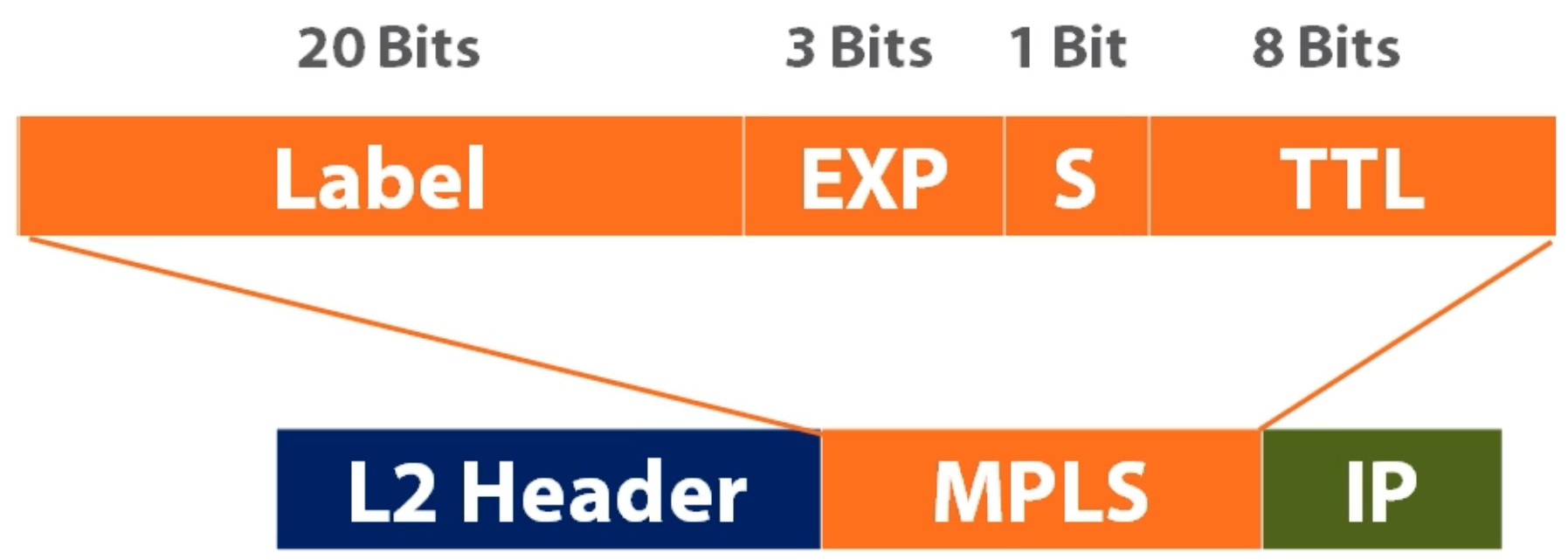
- Label - the MPLS label itself, determines destiny of the packet
- EXP- Experimental (not so much any more), used for QoS markings
- S - Boolean, if set to 1, it's bottom of the label stack. If 0, there's another label on the stack
- TTL - Time-to-live for loop prevention and hop count (as it is in IP)
Push vs Pop vs Swap - The swap operation means that the top label in the label stack is replaced with another - The push operation means that the top label is replaced with another and then one or more additional labels are pushed onto the label stack - The pop operation means that the top label is removed
Label Switched Routers
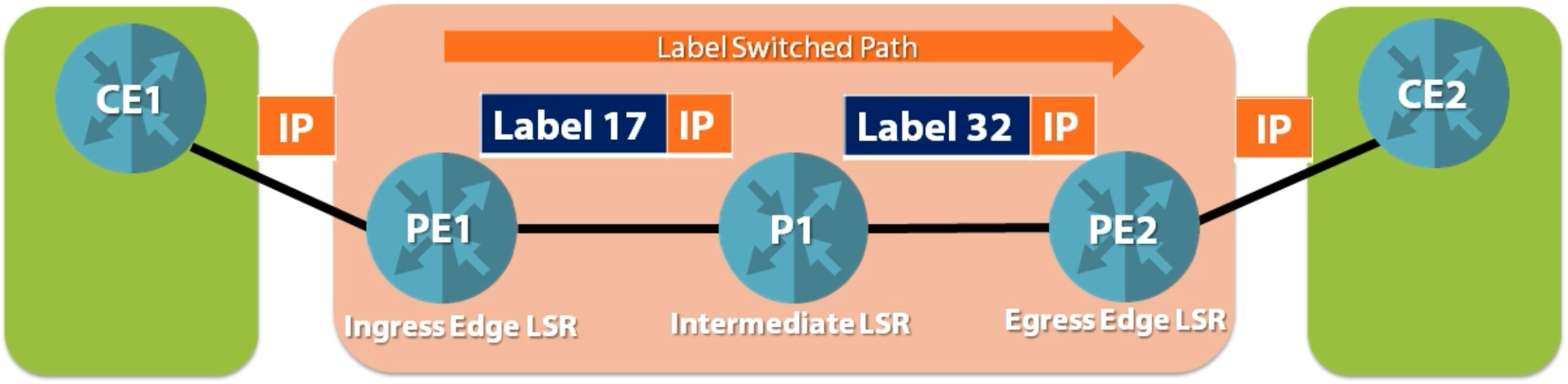
- A label switched router (LSR) is a router running MPLS
- LSR can be an ingress edge, intermediate or egress edge LSR
- A Label Switched Path (LSP) is the series of LSRs that switch a labeled packet
Forwarding Equivalency Class (FEC)
- Group of packets that are forwarded the same way through the MPLS network
- Every packet in the same FEC enters the MPLS network with the same label
- FEC can theoretically be based on many different things L3 destination prefix, QoS, L2 PVC, BGP next-hop, TE tunnel, link color, etc...